
What We Learned at ECR 2026: The Shift Toward Trusted Data in Clinical AI
High-Level Learnings from the Event floor
ECR 2026 brought together many of the companies building the next generation of clinical AI - and one theme came up again and again in conversations across the show floor: the demand for training data is accelerating, but the market itself is beginning to split.
After spending time in Hall X1, the AI section of ECR, the Avandra team observed two very different needs emerging among AI developers.
On one side, some teams are still primarily searching for the lowest-cost datasets they can access to train models at scale.
But among more advanced AI companies, particularly those moving closer to real clinical deployment, the conversation has shifted. The question is no longer simply how much data is available. It’s how meaningful that data actually is.
As clinical AI matures, developers are placing greater emphasis on:
Data curation
Clinical context
Consistency and completeness
Real-world diversity across health systems
Raw volume alone is no longer enough to build reliable clinical models. When algorithms begin operating in real patient environments, the trustworthiness of the data behind them becomes critical.
This shift will continue to shape the market over the coming years.
As the ecosystem matures, the winners will likely be the platforms capable of delivering both scale and trusted clinical quality, supported by deep partnerships with healthcare providers.
In clinical AI, trust in both the data and the source of that data will increasingly determine success.
From Conference Conversation to Real-World Impact
At ECR, Avandra also presented a joint poster with Harrison.ai demonstrating exactly how data quality influences clinical AI development.
The case study highlights how Harrison.ai built and validated an AI-driven imaging triage algorithm designed to help radiologists identify urgent cases faster - addressing one of the most pressing challenges in radiology today: rising imaging volumes and growing worklist backlogs.
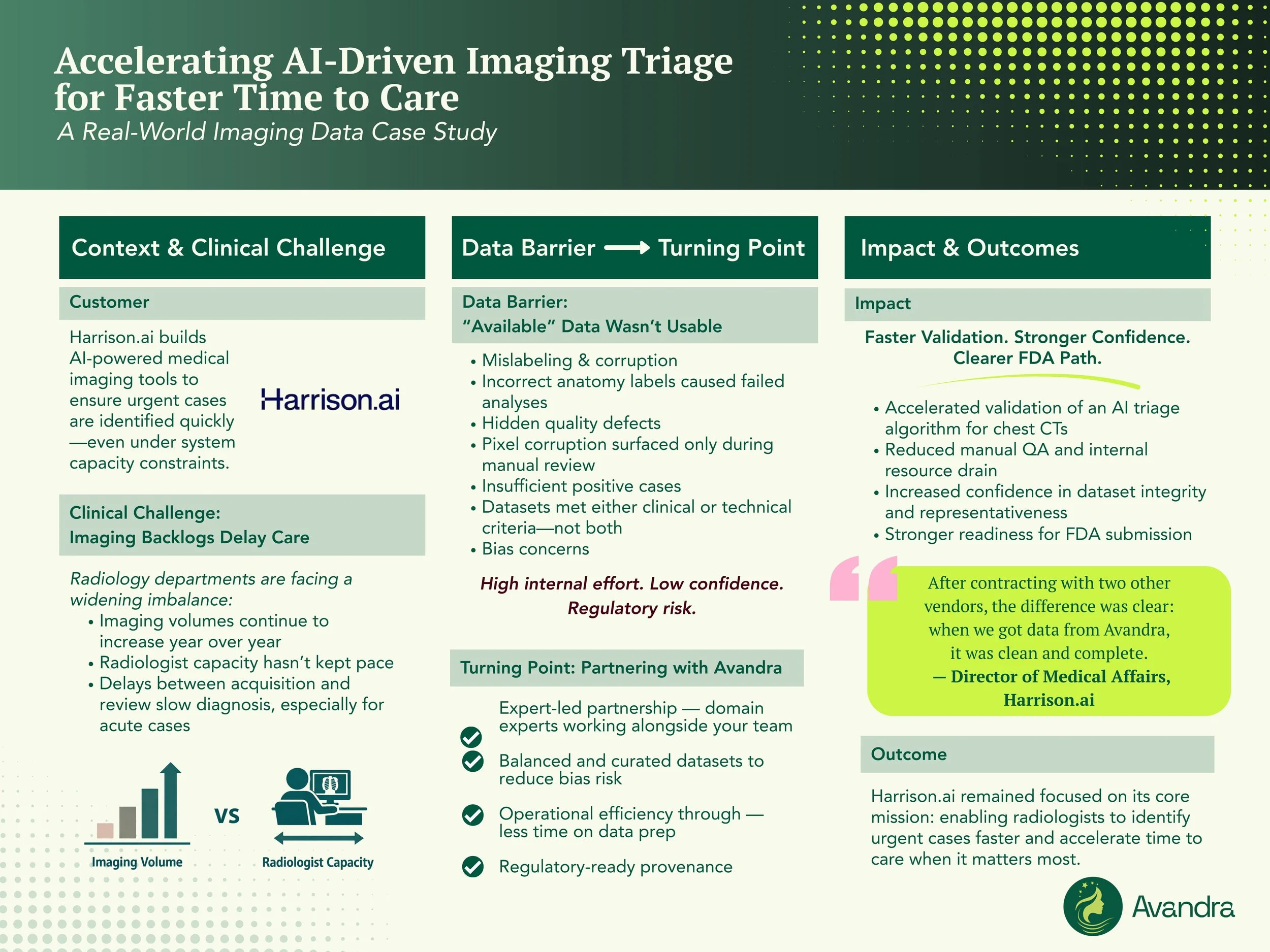
Avandra and Harrison.ai Case Study
During development, Harrison.ai initially sourced imaging data from multiple vendors but encountered significant issues, including mislabeled studies, pixel-level corruption, and incomplete datasets that required extensive manual review.
When the team partnered with Avandra, they were able to access curated, clinically-consistent imaging data sourced directly from trusted health system partners, allowing them to accelerate validation of their triage algorithm while preparing for FDA submission.
The result: faster development, stronger dataset confidence, and a clearer path to regulatory readiness.
You can read the full case study here:
Accelerating AI-Driven Imaging Triage for Faster Time to Care:
https://www.avandra.io/blog/accelerating-ai-driven-imaging-triage-for-faster-time-to-care
If you're exploring imaging datasets to support AI development or or regulatory readiness, the Avandra team would be glad to connect. Please reach out to us here: Partnerships@avandra.io
